
The Challenge
Australia is one of the most climate-exposed developed nations on earth. Drought, bushfire, flood, and heat are not future projections — they are present realities that destroy lives, property, and productive capacity with increasing regularity. At the same time, Australia possesses extraordinary natural assets: biodiversity of global significance, vast renewable energy potential, and agricultural land that feeds millions beyond its borders.
The political failure on environment has been one of captured debate. For decades, Australians have been asked to choose between economic growth and environmental responsibility — as though a serious nation cannot pursue both. This false binary has produced policy paralysis: inadequate action dressed in ambitious rhetoric on one side, and outright denial dressed in economic pragmatism on the other.
The machine age offers tools — satellite monitoring, predictive modelling, precision agriculture, intelligent water management — that could transform environmental stewardship. But tools without policy are merely capability without direction.
Where We Stand on Global Warming
The figure below is the instrument record: NASA's land–ocean global mean surface temperature, measured continuously since 1880 and shown as the departure from the 1951–1980 average. It is not a model and it is not a forecast. It is what thermometers, ships, buoys and satellites have recorded.
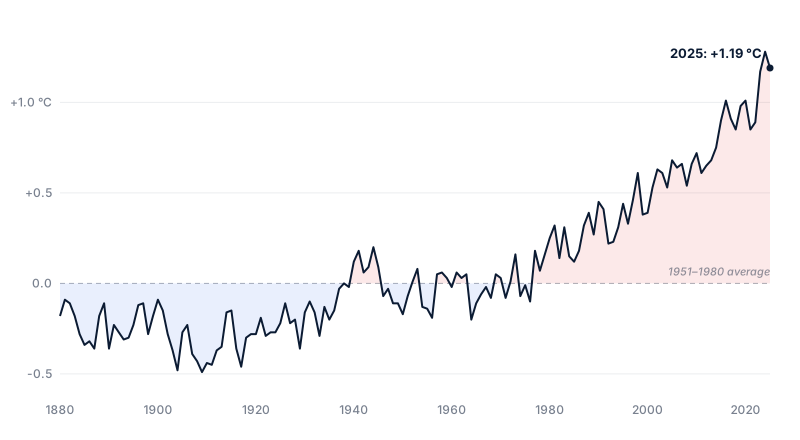
The most recent complete year, 2025, stands 1.19°C above the baseline. All ten of the warmest years in the record have occurred since 2015. Among scientists who publish on climate, the finding that human activity is the principal cause of this warming is effectively unanimous; in the peer-reviewed literature of the last decade, dissent runs below one paper in a thousand.
The party does not ask anyone to believe in global warming. Belief is the wrong instrument for a question of measurement. We ask people to read the record, and we build policy on what it says. Disagreement about the response — the balance of adaptation and abatement, the energy mix, the pace, the cost — is legitimate and welcome in this party. Disagreement with the thermometer is not a policy position, and a party that proposes to govern by evidence will not pretend that it is.
ARP Position
Environmental stewardship is a condition of national resilience, not a lifestyle preference. The Australian Renaissance Party practises geo-realism: evidence-led adaptation and practical risk management without ideological capture. ARP holds that:
Policy Mechanisms
- National Climate Adaptation Infrastructure Program: Pre-positioned investment in flood mitigation, bushfire resilience, water storage, and heat management for vulnerable communities — funded before disaster, not after.
- Environmental Monitoring Network: Satellite and ground-based monitoring integrated with AI analysis to provide real-time, publicly accessible data on water quality, soil health, air quality, and biodiversity indicators.
- Precision Agriculture Support: Co-investment with agricultural sector in AI-driven precision farming tools that reduce water use, chemical application, and land degradation while maintaining yield.
- Water Security Framework: Strategic investment in water infrastructure — storage, recycling, desalination where appropriate — treating water as the strategic resource it is, particularly in the context of the Ord River and northern development potential outlined in the Energy & Regional Resilience pillar.
- Biodiversity Investment Fund: Dedicated funding for conservation, habitat restoration, and species protection — not subject to annual budget negotiation. Managed with the same measurement discipline ARP applies to all policy areas.
What This Is Not
- Not climate denialism. The physical evidence is clear and ARP respects it. Disagreement about optimal response is legitimate; denial of observed reality is not.
- Not green ideology. ARP does not subordinate all policy to environmental objectives. It integrates environmental responsibility into a broader framework of national resilience, economic strength, and human dignity.
- Not anti-development. Development and environmental stewardship are compatible when policy is honest, evidence-driven, and long-term in orientation.